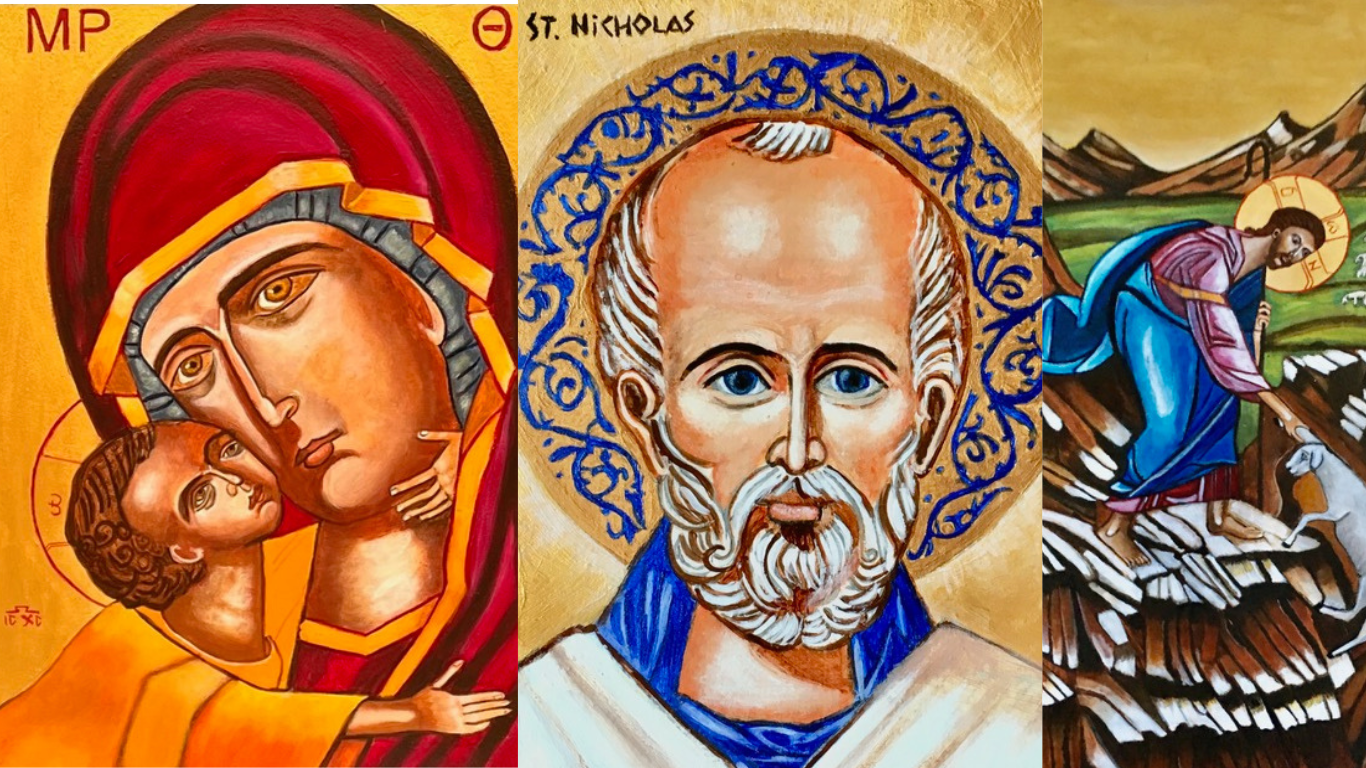
The word, ‘icon’ simply means, image. It can symbolize or encapsulate a great deal of information, especially for those who could not read. If you see an icon with a gold background and the image is staring at you, you may make the mistaken assumption that the icon is looking at you. He/she is not. If the icon has a gold background, the image is looking at the Triune God and reflecting the glory of God’s countenance. The iconographer has captured this moment.
Icons are generally copies of ancient icons. The earliest icons date from the 6th century A.D. and may still be appreciated at St. Catherine’s Monastery in the Sinai peninsula. There are several different icon schools: Greek, Russian, and Coptic are the most common. These date roughly from 1000 A.D. to 1500 A.D., although the ones in the Sinai Peninsula date much earlier. Today, there is a ‘modern’ style that is gaining in popularity.
Icons were done in a variety of media: the first ones were done with encaustic (using paint and wax). Later iconographers used egg tempera and ground minerals mixed together to create color, while using 14 carat gold leaf for the background. With the advent of oil paint in the 14th century and then acrylic paint in the 20th century, there are many new iconographers who are able to afford writing icons. Icons are not supposed to be 3-D accurate portrayals of faces & places, but are deliberately flat to distinguish between the ordinary world and the heavenly realm. It portrays a reality that can only be seen with spiritual eyes.
Some people complain that icon images never smile or seem sad or severe. We are looking at them from a 21st century perspective. Depicting being in the presence of the Holy Triune God to those of the early church and beyond was an event filled with awe and not an occasion to grin.
The Use of Color in Icons
Much had to be conveyed in an icon for those who could not read. They were an effective tool for communicating theological doctrine by using color and symbol. Here is a rough guide:
- RED: humanity, blood, sacrifice
- BLUE: divinity, heaven
- ORANGE, GOLD or YELLOW: the presence of the Holy Spirit
- BROWN: humility
- GREEN: eternal growth and newness of life in Christ, Pentecost
- WHITE: purity, holiness, perfection
- PURPLE (& occasionally dark blue): royalty
- BLACK: death (the only time black is ever used in icons is in the pupils of the eyes OR when portraying Satan or hell)
Christ traditionally wears a red inner garment and blue outer garment. This symbolizes that He set His godhead aside [blue] & took on our flesh [red]. When He ascended into heaven, He ascended as man and has not changed back. He is both fully God and fully man. Mary wears blue next to her body, because she bore the divine in her body. She is referred to as the Theotokos or God-bearer.
Rugged terrain (mountains) are frequently portrayed in icons as background, to symbolize the wilderness of sin that Christ came to rescue us from.
The right and left side of Jesus’ face is intentionally not ‘even’ or ‘equal’ in appearance. Why? The right side of His face represents the holy justice of God and the left side of His face represents God’s mercy; they come together perfectly in Christ: fully God and fully man. [see the Sinai Pantocrator for the best example of this.]
The bow mouth is small and always closed on all icons; this is to emphasize that it is more important to hear & listen than it is to speak, especially before God.
The long nose of an icon symbolizes that the sense of smell is attuned to the incense of prayers rising to Heaven (Rev. 8:4). In Scripture, God describes Himself as having ‘a long nose’ in Hebrew or what we translate as ‘slow of anger’ (first appears in Ex. 34:6, Pro. 14:29). Conversely, someone who is quick-tempered is described as short of nose, or what we would say as having a ‘short fuse’ or a ‘hot head.’ So by illustrating Christ and the saints with a long nose in an icon, we are symbolizing Jesus’ patience and graciousness towards us!
Ears are always shown in icons, & in a Pantocrator, both ears may be displayed to emphasize that Christ heard God & obeyed. Ears symbolize the choice of obedience; God never forces us to obey Him. Even Judas in the Last Supper is portrayed with ears.
The halo (a circle) symbolizes the holiness that God bestows upon all who believe in Him and, in the case of any icon of Christ, the halo is also a symbol of God’s eternal love for us that has no start and no end. If the halo edging is red or reddish, this symbolizes that the icon subject was a martyr, dying for the faith. Within Christ’s halo (only), there are frequently 3 Greek letters: Ο Ω Ν, (omega, omicron, nu) which make up the phrase, “ho ōn”, meaning “the Existing One” or “the Being One” or more precisely “He, Who Is.” This is a reference to Christ’s divinity, as the Old Testament reveals, “He who is” [I AM] to be the name God revealed to Moses at the burning bush.
The ‘IC’ and ‘XC’ are abbreviations for Jesus Christ: the ‘IC’ is the first and last Greek letters of ‘Jesus,’ while the ‘XC’ is the first and last Greek letters of ‘Christ.’ This was a common abbreviation of Jesus Christ from the late first century on.