Your cart is currently empty!
Meet The Artist
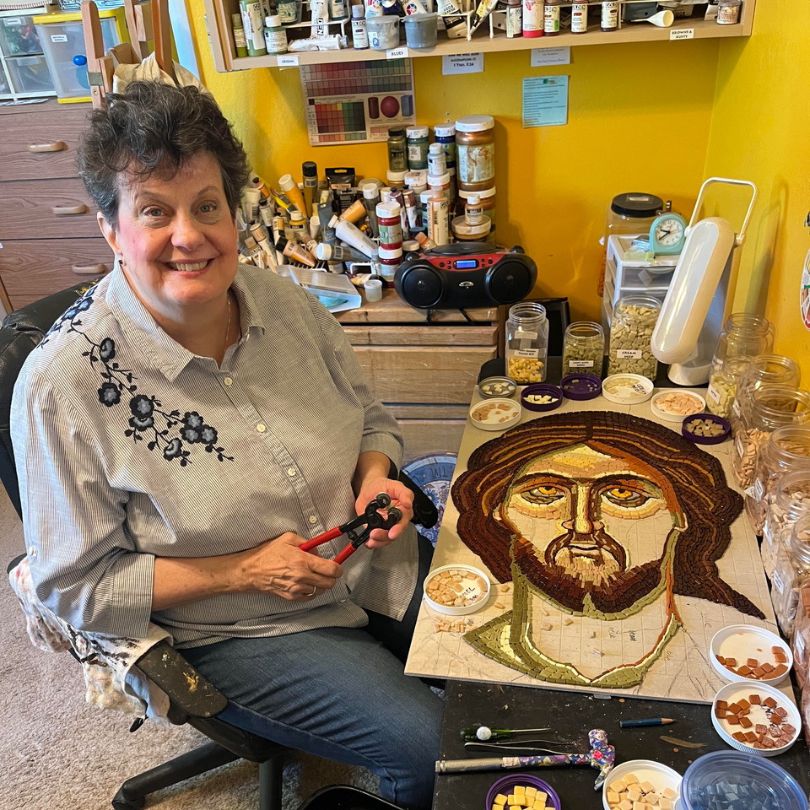
Sue Hague
I saw my first icon when I was eight years old.
I couldn’t take my eyes off of the icon of Mary. For one thing it was enormous, filling a wall along the side area of the church. I was about 8 years old and attending a high mass wedding of my aunt (my Dad’s sister & brother-in-law) at a Catholic church in Sacramento with my Dad before he married my step-mom, so he was responsible for my behavior. He was annoyed that I was just staring at the icon and not standing, sitting or kneeling at the appropriate times like I was supposed to. Everything there was so different from my brief church experience—but the icon of Mary and the gold around her and her expression—! I attended the Presbyterian church where my parents went before they divorced. They didn’t have big pictures of Mary in the Presbyterian church. In fact, they didn’t have big pictures of anything, though there were stained glass images of the OT and NT prophets and saints and then there was Christ, Peter and John in the balcony, but they were hardly noticeable (as well done as they were). They just weren’t the same as that icon of Mary. I didn’t know it then, but it made a deep impression on me.
Along the way, I became a Christian through my church, inviting Jesus into my heart and my life to lovingly rule and guide me when I started my sophomore year in high school.
As part of my Christian development, 4 years later finds me in eastern and western Europe the summer of Watergate (’74) for 2 months with a group of Christian college kids. We hit Italy and started to tour museums there and I saw very large icons of Mary sitting on her throne with baby Jesus in her lap and lots of angels all around her or Mary holding her dead Son. I saw an icon of Jesus hanging on a cross in vivid and anatomical detail. They were even larger and they used pure gold as the background on those! I was looking at an ancient past. I was gazing upon Cimabue and Giotto and Vladmir’s work still preserved. The light on the icon was angled just right, so that the gold was dazzling! I didn’t want to walk away; I just wanted to stare at them all slowly and soak it all in. Reluctantly and prodded, I went on to view all the other art of the Masters at the museums. But the impression became deeper.
Fast forward to 2008 when I was hanging out a great deal with our then Anglican Bishop, John-David Schofield, who had become my spiritual Dad. If you had ever visited his place, you knew that he had icons all over his house from all over the world. I used to comment on them and wish that I could do something as beautiful as them. He said, ‘You can!’ in his bright and chipper way. He showed me some icons that friends of his had done thru an icon class taught at our old retreat center just below Yosemite and they were really good. He encouraged me to take a class from a friend of his who taught iconography. I was convinced that I couldn’t create that sort of beauty after a lifetime of family and teachers telling me I couldn’t draw. After a 3 year long pep talk from him, I finally screwed up my courage and signed up for a class with the icon teacher in 2011, who was in his diocese at an Anglican church in Bakersfield, CA . That was 13 years ago and I haven’t looked back. In fact, I am now doing mosaic icons as well and hope to start working on bas relief icons in clay this summer.
I am grateful to my teacher for setting me on my way with the nuts and bolts of icon creation, but I am truly, eternally grateful to Bp. John-David for telling me of the symbolism of icons and the encouragement he provided. He was a walking wealth of information re: saints of the Church and the symbolism of the saints portrayed in the icons that he loved to share with me. He gave me books and articles he would come across, and became my private cheering section as I learned to write icons. As he ‘unpacked’ icons for me, it gave me a zeal to learn all I could about their symbolism, as well as meeting a lot more saints I didn’t know about in our church history. Bishop John-David joined the ‘clouds of witnesses’ in 2013, but I know that he is still cheering me on.
I came to realize that as a Protestant I had a deep longing for symbolism in my life—for something visual, not written in words, not articulable. The Orthodox and the Catholics were onto something with their images of Christ, Mary, various saints & stories from the Bible writ large on the walls of their churches. In the modern world we believe that text conveys meaning better than a picture. Yet for me, icons bind up a Reality beyond words. All of us have a hunger for symbolism though we may deny it. ‘We live by and in our symbols.’ As Leanne Payne states in her book, The Healing Presence,[p. 140] “When a sound symbolic system (an integrated way of seeing reality) is missing, a lesser one takes its place. When great and good symbols of God, the cosmos, fatherhood, motherhood, masculine, feminine, and so on are rejected or are simply absent from the psyche, then lesser images (and even entire symbolic systems) develop to take their place.” An influential book I read recently reinforces the importance of symbolism in our lives. It is by Joseph Leo Koerner entitled, The Reformation of the Image. I saw a documentary [“Hitler: A Career”] done by Germans in the early 70s of Nazi Germany and I was fascinated with all the symbolic images and art that were regularly paraded about to the German people and how passionately they embraced it. I posit that because the Germans had no Christian symbolism within their Protestant churches for nearly 500 years,, they were starved for it when Hitler came to power. I realized with a shock that this was a [negative] legacy of the Reformation when the ‘reformers’ smashed all the art in German Catholic churches calling it evil. I had no idea how far-reaching, prolific, or vigorously symbolism was incorporated into their Nazi dogma. Words to a Nazi ‘hymn’ that was regularly sung by Hitler Youth states, “No evil priest can prevent us from feeling that we are the children of HItler./Away with incense and holy water!/The swastika brings salvation on earth!” A generation of impressionable children sang that ‘hymn.’ I see the hunger even more prevalent today as the world abandons sound godly symbolism for the demonic.
Icons are chock-full of symbolism. Just to name a few symbols. . . If you see an icon with lots of rocky cliffs or crevices, that represents the wilderness of sin. Jesus frequently wears blue and red—why? The red is always next to His body and represents His humanity, and the blue mantle (outer garment) represents His divinity. He didn’t regard equality with God a thing to be grasped, but emptied Himself by becoming man (Phil. 2:2:6ff). He is both fully God and fully man. All that theology in just two colors! His halo frequently has 3 Greek letters within His halo: Ο Ω Ν, (omega, omicron, nu) which make up the word ὁ ὢν (“ho ōn”), meaning “the Existing One” or “the Being One” or more precisely “He, Who Is.” This is a reference to Christ’s divinity, as the Old Testament reveals, “He who is” [I AM] to be the name God revealed to Moses at the burning bush. The compact theology expressed in icons always astonishes me!
The backgrounds of icons are often gold—it looks like the icon is ‘staring’ at the viewer, doesn’t it? Not so! The icon is staring at the Triune God and reflecting the glory of the perfect and holy God that through this icon we can behold and share. I could go on and on with this. . . there is so much symbolism to unpack!
There are prayers that are prayed over a completed icon before it is given to the recipient by clergy, that really resonate with me as well—that the viewer would be drawn in, caught up into the eternal presence of the Father whenever they view an [this] icon. For me, icons are an evangelical instrument to draw people to Christ, especially those who do not know Him. St. Francis told his followers, ‘preach the Gospel; when necessary use words.’ I like to convey the message of Christ in each icon and in fact that is what I am praying for throughout the process of writing the icon.
So yes, I’ve said that I “write” an icon. Why the word, ‘writing’ instead of ‘painting’ an icon? The simplest explanation is that icons are meant to convey Scripture in visual form. They are not simply artistic creations but are witnesses to the truth of Scripture. Far from being imaginative compositions of the the iconographer, they are more like scribal copies of the Bible. As the iconographer (the one who writes the icons) works on the icon, it becomes more a form of prayer than art and ideally you believe your hand is guided by God to create the final image. (However for those not familiar with this subtlety, I am also happy to say that I paint religious icons as my vocation and occupation.). Christ is the Word Made Flesh, so again, it seems more appropriate to say the word, ‘write’ rather than ‘paint’. This is the word that the ancient iconographers use, so I follow their precedent and use the same word as well.
In the long tradition of writing an icon, the iconographer does a confession of their sins before they begin an icon, so both the icon and the writer begin with a clean slate. I usually am doing a continual confession each day as I begin, so that the slate is daily clean as I continue to work on an icon. While writing the icon, ideally the iconographer is offering a paean of praise to the Triune God with each stroke of paint/tile, so that at the end, what is produced is not a ‘pretty picture’ of Jesus or the saints or some scene from the Bible, but instead a testimony of PRAISE to Father, Son, and Holy Spirit! Isn’t that lovely?
That’s why icons are NOT idols—we do not worship the image any more then an early Reformer would have worshipped the paper or ink the Gospels were written on. We may honor the image (or the Bible) but we do not worship it. No one prays to an icon or to the saints portrayed in an icon. We ‘pray through the saints to God in Christ’. Ultimately, the saints don’t answer our prayers! They echo prayers with greater profundity, insight, and love. And so say the Scriptures, ‘The prayers of a righteous man has great power in its effects.’” Jas. 5:16 [Hahn, p. 17]. It is much like asking for prayers from a friend here on earth. “While there has always been a danger of misguided people deifying Mary (or any other saint), the real doctrine about invoking saints is that we may ask them to pray for us just as we ask any saintly person here in the earthly realm. Many Protestants mistakenly believe the doctrine of “the communion of saints” means the saints in and of themselves would have to be “omniscient” to hear such requests, but the actual doctrine comes from a radical understanding that those who die in Christ share His life in astonishing ways, including, in Him, a participation in His very divinity. This is believed to be what Peter meant when he said, “We have become partakers of the divine nature” [2 Pet. 1:4] and Paul, when he said “We have the mind of Christ.” [1 Cor. 2:15-16] This is also understood to be the meaning of all the talk in the New Testament about glorification and God sharing His glory with us. In the Eastern church the doctrine is called Theosis.” [Rev. C.L. Raines]
Icons are rendered two dimensionally and are not very lifelike. This is done intentionally. Icons are created to represent Biblical events, the people of the Bible, Christ and the saints; but if they are too realistic, the concern is that they would be confused with idols, which is defined as an ‘object of worship’ according to the dictionary definition. So icons aren’t to be worshipped, but to serve as reminders. The purpose of an icon is to draw us in—lead us—into His Presence, His rest, and His peace. It’s an invitation to slow down, tune out and abide in Him, to exhale, and be still before Him. It is a chance to think and pray and muse, and especially listen, as we gaze upon an icon—be it of Christ or of one of His saints or a story from the Bible.
I am especially encouraged when I write or gaze upon a saint icon—‘those clouds of witnesses’ from Heb. 10—that I know nothing about. I love learning about them and the hardships they overcame and the struggles they endured to be remembered in this fashion.
There is often quite a spiritual battle going on as I write an icon: Satan and his demons do not want me to praise God as I work! It is not unusual for me to fast while working on an icon as a way to sharpen my focus on Christ while I work. Again, this is part of the long tradition of iconography.
As St. Gregory the Great has said, “If you do not delight in higher things, you most certainly will delight in lower things.” I am reminded, too, of the quote, “Nature abhors a vacuum” and I think that the hunger for symbols in us demands to be filled with something. Never forget that symbols are powerful, as Satan well knows.
Have you thought about what your symbols might be? Is it the Apple logo, the MdDonald arches, the AC/DC rock band logo, the ecology symbol, or the rainbow peace sign? We have unconsciously co-opted the symbols of the world as part of our ‘identity.’ Right now might be a good time to sit down and inventory your symbols. If they are worldly, then consider symbols within the Church. Research them and explore how they came about. There are many to choose from besides just the cross (though that is always a good start).
Iconography for me is both my mission and my vocation. I truly believe this is why the Lord put me here on earth. This is the unique pathway He gave me to express His love to the world around me.